Banker's Digest
2026.05
Should banks let “lobsters” into their systems?
Win Way Ngo


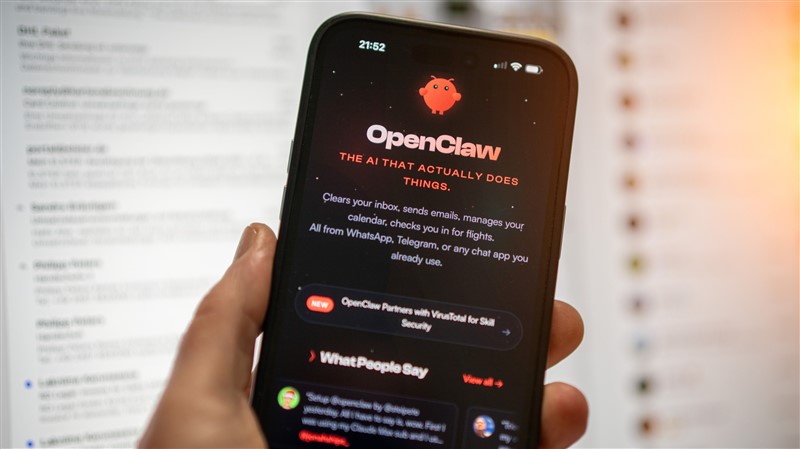
One of the breakout AI trends of early 2026 was OpenClaw, nicknamed the “lobster” because of its crustacean-inspired branding. Deploying OpenClaw quickly became known online as “raising a lobster.” The term resonated because these new agents no longer behave like simple tools, but more like living systems which must be fed, managed, and carefully controlled. After GPT-4 pushed AI reasoning and multimodal capabilities to new heights, the market began demanding more than chatbot-style interaction. Users wanted AI systems that could independently complete tasks. Auto-GPT, launched in 2023, demonstrated this possibility by autonomously breaking tasks into steps and deciding what to do next. Nevertheless, it also exposed a major weakness: after going through long, complex processes, agents still often arrived at incorrect conclusions. The next phase of development therefore focused less on giving AI complete freedom, and more on introducing structure and governance. The industry realized that practical agents must be observable, interruptible, and manageable. Workflow tools such as n8n embedded AI into visual process flows, allowing human approval before executing sensitive actions. Yet rigid workflows also revealed limitations, and agents struggled whenever situations fell outside predefined scenarios. The challenge then became how to allow AI to operate independently within clearly defined boundaries. This problem was first solved effectively in software development. Claude Code, introduced in 2025, demonstrated that AI does not need universal intelligence to be useful. Specializing in coding tasks, understanding codebases, using developer tools, editing files, executing commands, and debugging made it capable of handling real-world workloads. Its breakthrough feature was the later addition of “skills.” Traditionally, even advanced AI models behaved like new employees who needed fresh instructions for each task. Skills changed that paradigm by converting institutional knowledge, which previously was locked inside senior engineers’ experience, team documents, and code review habits, into reusable capabilities. The real transformation was not about completing individual tasks, but about preserving and scaling organizational knowledge. This concept was later extended into ideas such as colleague.skill, where the expertise of top-performing employees could be distilled into AI-readable operational intelligence. Thus, valuable institutional know-how no longer needs to disappear when experienced staff leave. If Claude Code gave AI agents “working claws,” OpenClaw provided them with a body capable of long-term operation. Rather than a single breakthrough feature, it integrates memory, retrieval, scheduling, and reflection into a sustainable operating structure. OpenClaw introduced a structured memory system which stores contextual information as manageable files, retrieving relevant history when needed. Its Heartbeat mechanism periodically reawakens the agent to reassess tasks and pending actions. To prevent memory from becoming overwhelmed with noise over time, it later added a “dreaming” mechanism which filters repeated patterns, only consolidating meaningful information into durable memory. Despite these capabilities, OpenClaw soon faced backlash due to operational and security concerns. The first was permission hallucination. Earlier tools, like Claude Code, still operated within tightly supervised environments. OpenClaw, in contrast, functions as a continuously connected autonomous agent capable of interacting through multiple interfaces while independently executing its tasks. Once an agent simultaneously controls chat access, files, browsers, command lines, and scheduling systems, the risk is no longer limited to incorrect answers. Misuse of permission becomes a potential operational and cybersecurity disaster. The second challenge emerged from the expansion of its skills ecosystem. ClawHub is an open registry for skills and plugins, effectively turning OpenClaw into a software platform with a growing external ecosystem. This also amplified risk: malicious skills could not only produce wrong outputs, but also execute unauthorized commands, leak sensitive data, or introduce external threats into enterprise systems. The third challenge was economic. While OpenClaw supported local models and self-hosted inference services, many users have still relied on large cloud-based models for stronger reasoning performance. Moreover, the architecture itself consumes enormous numbers of tokens, constantly rereading context, recalling memory, and checking task progress. Users pay not only for work performed, but also for the AI to continuously remember what it was doing. Some background operations reportedly consume tens of thousands of tokens for seemingly simple interactions. As these “lobster crises” intensified, the industry shifted toward building governance frameworks around agents. Hermes Agent focused on learning, turning experience into reusable Skills. NVIDIA’s NemoClaw emphasized governance, embedding OpenClaw into controlled execution environments with sandboxing, state management, model request routing, and network policy controls. This has led to growing discussion around the concept of the harness – referring to the governance layer that enables humans to truly control an agent. Harnesses manage permissions, workflows, error handling, state continuity, and operational oversight within a unified framework suitable for enterprise deployment. At present, immature autonomous AI agents are clearly unsuitable for direct deployment inside banks, but the banking industry should still not ignore their evolution. The real lesson is not the “lobster” itself, but the broader shift it entails: extracting the expertise embedded in experienced traders, credit officers, and compliance specialists to be leveraged by AI. A bank’s greatest asset has never been its systems, but the irreplaceable expertise accumulated in the human judgment of its experts. If AI can preserve and transfer that expertise across generations, the transformation will extend far beyond cost efficiency. It will redefine how institutional knowledge survives over time. The author is director of the Fin & Tech Village at TABF