Banker's Digest
2026.04
TABF talent matching event highlights career pathways in finance
Su Wei-hua


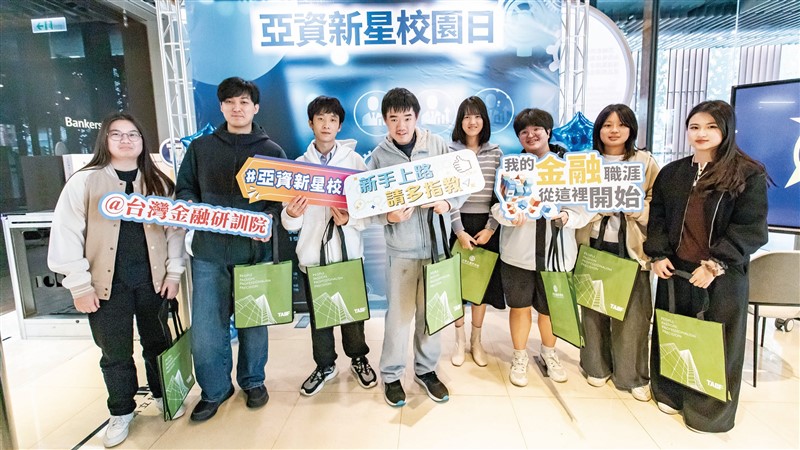
In support of the government’s policy to position Taiwan as an Asian asset management center, this January, TABF hosted a campus competition, bringing together top-performing students from university competitions to participate in a proposal contest. The Rising Stars Campus Day featured five universities: National Taiwan University, National Cheng Kung University, National Chung Cheng University, Fu Jen Catholic University, and Chung Yuan Christian University. Alongside that event, the Financial Talent Matching Forum also invited students from across institutions to engage directly with industry professionals from six financial institutions: Yuanta, Taishin, SinoPac, Hua Nan, E.SUN, and DBS. Together, these initiatives successfully established a comprehensive talent incubation pipeline spanning campus training, competitive recruitment, and industry engagement. In his opening remarks, TABF President Alpha Kao emphasized the role of TABF as a cradle of financial talent. “Beyond just job placement, our mission is to build a bridge that precisely connects outstanding talent with the right career opportunities.” In contrast to traditional campus job fairs, TABF aims to create a platform to more precisely and effectively facilitate meaningful connections between employers and top-tier talent. Kao pointed to a significant increase in demand for legal, cybersecurity, and wealth management professionals in the financial sector amid rapidly growing demand for wealth management services. The financial sector must move beyond traditional stereotypes, and better understand the expectations of the next generation regarding values and work-life balance. No longer a one-way recruitment process, talent matching has become a two-way dialogue. The event also incorporated interactive AI-powered career exploration tools, helping students better understand their strengths and identify suitable career paths – from back-office support roles to front-line international assignments. The forum opened with a keynote by C.C.Chen, Independent Director of Yuanta Bank. Yuanta’s strength lies in its dominant securities franchising and robust research. Its brokerage and cross-border trading businesses consistently rank first in market share, while its flagship ETFs such as 0050 and 0056 have become household names. Yuanta’s distinctive management philosophy centers on rigorous risk discipline, reflected in superior asset quality metrics such as loan loss provisioning ratios. Yuanta emphasizes both performance and people in its talent development, offering growth opportunities for both experienced hires and fresh graduates. A member of the Sustainable Finance Pioneers Alliance, Yuanta also fosters a supportive workplace culture by providing parental and family care leave benefits exceeding statutory requirements. Taishin Bank has demonstrated its connection to academia through its long-standing Early Win Internship Program and highly competitive Management Associate (MA) Program. High-performing interns benefit from a fast-track mechanism that allows them to bypass initial screening and proceed directly to MA interviews, with a high conversion rate to full-time positions. For graduate students, Taishin offers an MA program across eight tracks, including a newly introduced AI and Data Science track. The program features comprehensive job rotations and a mentorship system led by senior executives, reflecting a clear performance-driven approach, with a starting salary approaching NT$70,000 per month, and guaranteed annual compensation exceeding NT$1 million. Chang Shun-Yu, Head of Talent Development at SinoPac Bank, highlighted the opportunities SinoPac is creating through regional expansion and digital empowerment. Following its acquisition of King’s Town Bank, SinoPac now operates 191 domestic branches, completing its presence in central and southern Taiwan, while expanding internationally into Vietnam, Cambodia, and Los Angeles. Chang encouraged students to embrace overseas assignments and adopt a global perspective. SinoPac has fully embedded digital transformation into its operations, from company-wide adoption of AI tools such as Copilot, and development of proprietary platforms like SinoPac Cloud Learning. Its chairman has learned Python. Guided by its vision of transforming finance for a better life, SinoPac emphasizes its core values of continuous learning, curiosity, and openness. With 186 locations worldwide and 16 overseas branches, Hua Nan Bank reported strong financial performance last year ranking second among the state-owned banks for net profits at NT$26.5 billion. This performance is reflected in generous compensation, with average bonuses of seven months’ salary, and childbirth subsidies of up to NT$200,000. Unlike private banks that emphasize specialization, Hua Nan promotes cross-functional growth, allowing employees to gain experience across retail banking, corporate banking, deposits, remittances, and foreign exchange. It also offers salary increases tied to professional certifications such as the Certified Financial Professional (CFP), and its talent pool system enables high performers to advance to managerial roles within five years. Its MA program targets candidates with strong academic and language skills, combining the stability of a state-owned bank with the dynamism of the private sector. E.SUN Bank introduced its well-established talent development system. 80–90% of its management positions are filled through internal promotion, demonstrating its commitment to long-term career growth. E.SUN strongly encourages cross-functional rotations and a combination of domestic and international assignments, with employees eligible to apply for transfers after just two years of service. In response to the global expansion of companies such as TSMC, E.SUN has rapidly grown its overseas presence in locations such as Fukuoka and Dallas, offering employees opportunities to participate in acquisitions and strategic decision-making. ESG is embedded in E.SUN’s corporate DNA, with initiatives spanning green finance and multi-generational sustainability. In line with Taiwan’s asset management center policy, wealth management will be a key growth area; E.SUN is actively recruiting interns, relationship managers, and private banking advisors with both cultural awareness and digital expertise. The only foreign bank represented, DBS Bank highlighted its strong Asian positioning, rooted in Singapore and reinforced by its acquisition of Citibank’s consumer banking business in Taiwan, which makes it the largest foreign bank in the market. Guided by its vision of Best Bank for a Better World, DBS emphasizes data-driven innovation and defines talent through its PRIDE values framework. Its structured internship program serves as a key pathway into its MA program, with top performers often receiving full-time offers. DBS offers an ideal platform for younger professionals seeking flexibility and international exposure to build global careers while still being based in Taiwan. From building capabilities during academic study to facilitating real-world career connections, the Financial Talent Matching Forum helped bridge the gap between education and practice, marking a significant milestone in Taiwan’s financial talent development. President Kao concluded that TABF will continue to serve as a strong backbone for talent advancement, not only as the starting point for students entering the workforce, but also as a long-term partner on professional certification, career progression, and continuous learning. Through these efforts, TABF aims to nurture the next generation of financial professionals to underpin the growth of Taiwan’s asset management industry.